
The Invisible Interface: Harnessing AI to Reshape Consumer Experiences in Healthcare 2026
Introduction: The Paradox of Modern Healthcare
We stand at a peculiar intersection in the history of medicine. Inside the operating theater, we have surgical robots performing microsurgery with sub-millimeter precision and genomic sequencing guiding personalized oncology treatments. Yet, the moment a patient steps out of that clinical bubble—or worse, tries to step in—they are often met with an administrative infrastructure that feels like a relic from the fax machine era.
It is 2026. The "patient" has evolved into the "healthcare consumer." They order groceries with a voice command and track deliveries in real-time. Yet, to book a simple consultation or retrieve a lab report, they are frequently subjected to the "Press 1 for English" purgatory, placed on indefinite hold, or forced to physically queue at a front desk.
This disconnect is no longer just a nuisance; it is an existential threat to hospital viability. The friction at the "Digital Front Door" is where patient loyalty is lost, revenue leaks, and clinical staff burn out.
The future of healthcare isn't just about better drugs or smarter scanners; it is about Ambient Intelligence—technology that dissolves the barriers between the patient's need and the provider's care.
"Kiyado Labs is a global Health Tech innovator specializing in AI-driven hospital automation, patient flow optimization, and clinical workforce enhancement tools designed to reduce operational bottlenecks."
The "Triple Threat" Stifling Hospital Growth
Before we can discuss the cure, we must brutally diagnose the disease. Healthcare providers today—whether sprawling multi-specialty hospitals or agile private clinics—are facing a "Triple Threat" that threatens operational stability and profitability. This is not a future projection; it is the reality of the P&L sheet today.
The operational chassis of the average hospital is buckling under three specific pressures: Revenue Leakage via "Ghost Patients," Administrative Burnout, and the Fragmented Consumer Experience.
1. The Revenue Hemorrhage: The Cost of Silence
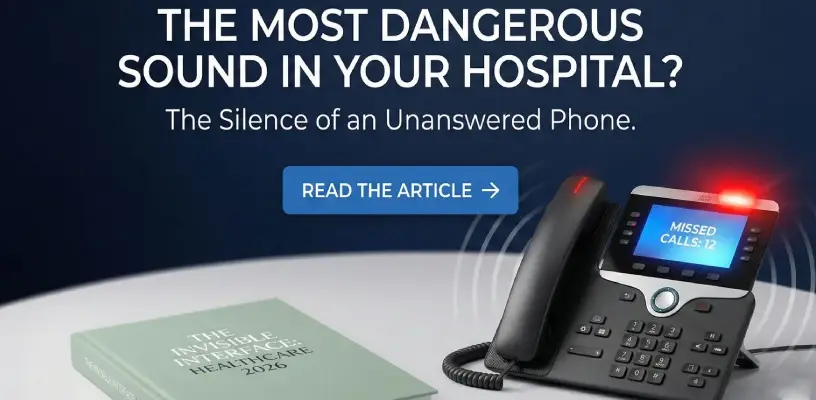
In any other industry, a missed sales opportunity is unfortunate. In healthcare, it is catastrophic. The most dangerous sound in a hospital administration office is not a shouting patient—it is the silence of an unanswered phone.
Current data indicates that nearly 30% of inbound calls to clinics go unanswered during peak hours or after operational shifts. In a volume-driven model, every one of those missed calls is a potential patient who, finding no answer, simply calls the competitor down the street.
But the leakage doesn't stop at the initial contact. We are facing an epidemic of "No-Shows." Average patient no-show rates currently range from 18-30%. These are "Ghost Patients"—slots on a calendar that represent unrecoverable revenue.
2. The Invisible Tax: Administrative Burnout
If revenue leakage is the financial cost, burnout is the human cost. Front-desk staff and care coordinators are currently spending a staggering 60-70% of their time on low-value, repetitive tasks. These are high-functioning humans whose cognitive load is entirely consumed by giving directions, repeating price lists, and confirming appointment times.
We are essentially asking our staff to be robots. It is an inefficient use of empathy, which should be reserved for complex care coordination, not recitation of the parking fee structure.
3. The Broken Journey: A Fragmented Patient Experience
Finally, we must address the experience gap. The modern patient's expectation is set by Amazon and Uber, not by other hospitals. They demand immediacy, transparency, and fluidity.
However, the reality is often characterized by long hold times and complex IVR menus. This friction leads to reduced satisfaction and poor patient engagement. In an era where healthcare is becoming increasingly consumerized, patients will churn to providers who respect their time.
The Strategic Shift: From "Call Center" to "Digital Front Desk"
The solution to the "Triple Threat" is not to hire more humans to answer phones faster; it is to fundamentally decouple "volume" from "effort." We must move beyond the antiquated concept of a Call Center—a reactive, labor-intensive cost center—and embrace the "Digital Front Desk."
This is the genesis of VOXYLO.
VOXYLO is not a chatbot. Chatbots are static, button-mashing frustration engines that offer generic FAQs. VOXYLO is a specialized Vertical AI agent designed specifically for the healthcare sector.
- Zero Missed Calls: By deploying an AI that operates 24/7, we solve the "Zero Missed Call" mandate immediately. Whether a patient calls at 2:00 PM or 2:00 AM, the interaction is captured, and the transaction is completed.
- Omnichannel Context: Unlike generic tools, VOXYLO seamlessly switches context between Telephony (SIP Trunking) and Digital Messaging (WhatsApp Business API). A patient can start a conversation via voice and finish it via text.
- Revenue Protection: By automating the booking process and employing a "No-Show Reduction Loop"—which includes proactive voice reminders and smart rescheduling—we can recover the 15-30% of revenue lost to empty slots.
The Architecture of Action: Interoperability & Logic
The fatal flaw of most "healthcare AI" on the market today is that it is disconnected from the hospital's brain—the Hospital Information System (HIS). A bot that can chat but cannot check the doctor's real-time roster is effectively useless.
VOXYLO is architected differently. It is built on a Deep Integration model, utilizing a robust API gateway to connect with major HIS/EHR standards (HL7, FHIR). This allows the AI to perform Real-Time Read/Write Operations:
The "Smart Appointment Engine"
The AI reads live doctor schedules—accounting for OPD hours, rounds, and leave status—to prevent double-booking. It negotiates a slot with the patient using natural language and writes that appointment directly into the HIS.
Medical Triage & Safety Protocols
We are dealing with health, not retail. Latency and accuracy are matters of life and death. VOXYLO utilizes ultra-low latency engines (<500ms) to ensure conversations feel natural. More importantly, it is equipped with Medical Triage Logic. It recognizes urgent keywords like "chest pain" or "heavy bleeding" and instantly bypasses automation to alert the Medical Officer on Duty (MoD).
The Connected Ecosystem: Beyond the Front Door
While VOXYLO secures the "Digital Front Door," a truly smart hospital requires intelligence at every stage of the patient journey. Once the patient is admitted, the operational challenge shifts from access to coordination.
This is where the synergy between our platforms becomes critical:
- Intake (VOXYLO): Fills the funnel and protects revenue.
- Coordination (whtai): Takes over the internal orchestration, turning chaotic WhatsApp groups into trackable, AI-supervised hospital workflow solutions for nurses and support staff.
- Exit (Medix): Acts as the backend engine, utilizing predictive AI for billing and discharge automation, ensuring that the bed turnover rate matches the intake velocity.
This is the vision of the "Self-Driving Hospital": VOXYLO fills the funnel, whtai streamlines the stay, and Medix accelerates the exit.
The Economics of Automation: Modeling the ROI
In the boardroom, technology is only as valuable as the balance sheet it improves. The deployment of VOXYLO is not merely an operational upgrade; it serves as a dual-engine for financial performance, pulling two distinct levers: Efficiency (Cost Savings) and Growth (Revenue Protection).
1. The Efficiency Lever: Compressing OpEx
The traditional model of scaling a contact center is linear: as call volume grows, headcount must grow. This is unsustainable in a high-inflation labor market. VOXYLO breaks this dependency by introducing "Infinite Burst Capacity."
By automating 80% of routine interactions—such as appointment bookings, FAQs, and price inquiries—hospitals can effectively reduce call center manpower requirements by 60%. This allows for the redeployment of staff to complex care coordination rather than data entry.
2. The Growth Lever: Plugging the Leaks
The "No-Show" epidemic is a silent killer of hospital margins. By implementing the "No-Show Reduction Loop," VOXYLO is projected to recover 15-20% of potential revenue currently lost to empty slots. Furthermore, ensuring that zero calls go to voicemail means capturing every potential consultation and diagnostic test that would otherwise drift to a competitor.
The C-Suite Inquiry: 5 Tough Questions on AI Adoption
As a leader evaluating AI infrastructure, healthy skepticism is required. Here are the five most critical questions we encounter from hospital executives, answered with transparency.
Q1: "Will my patients hate talking to a robot? Is the empathy real?"
Answer: This is not the robotic "Press 1" experience of the past. VOXYLO utilizes Ultra-Low Latency Speech-to-Text (<500ms) engines to ensure conversations are fluid, handling interruptions and pauses naturally. The AI maintains a supportive, professional tone on its 1,000th call just as it did on its first, eliminating the variance found in human staff after long shifts.
Q2: "What about Hallucinations? Can the AI give wrong medical advice?"
Answer: This is a critical safety rail. We do not use generic "open" models for clinical interactions. Our Conversational Core is fine-tuned specifically on medical datasets to minimize hallucinations and ensure clinical accuracy. Furthermore, strict guardrails prevent the AI from offering diagnoses; its role is administrative and logistical, with immediate escalation protocols for clinical triage.
Q3: "Our HIS is legacy. Can you actually integrate?"
Answer: Interoperability is our core competency. We do not require you to rip and replace your existing infrastructure. VOXYLO acts as a middleware layer, connecting via API to major standards (HL7, FHIR) and proprietary systems. If your HIS has an API, we can read the schedule and write the appointment.
Q4: "Is our patient data secure in the cloud?"
Answer: Absolutely. We employ a "Privacy-First" architecture. All voice and text data is encrypted in transit (TLS 1.3) and at rest (AES-256). We are fully compliant with HIPAA, GDPR, and PDPA, ensuring that while we leverage the cloud for scalability, your governance and compliance standards remain uncompromised.
Q5: "Does it support our diverse local population?"
Answer: Healthcare is hyper-local. VOXYLO auto-detects and speaks 30+ languages. This effectively removes language barriers at the front desk, ensuring that non-native speakers receive the same level of access and care clarity as anyone else.
Conclusion: The Hospital of 2029
We are moving toward a future where technology becomes invisible. In the hospital of 2029, there will be no waiting on hold, no "missing" lab reports, and no administrative clipboards. The "Digital Front Door" will be wide open, welcoming, and intelligent.
The winners in this next era of healthcare will not necessarily be those with the biggest buildings, but those with the smartest workflows. By adopting Ambient Intelligence today—through platforms like VOXYLO for access, whtai for coordination, and Medix for discharge—you are not just buying software. You are building a resilient, scalable infrastructure capable of putting the "Care" back in Healthcare.
The tools are ready. The question is: Are you ready to let them work?
Your Next Strategic Step
If you are ready to audit your current "Digital Front Door" efficiency, let's calculate the exact revenue potential of recapturing your missed calls.
I can generate a customized "Lost Revenue Calculator" based on your clinic's current call volume and ticket size.