
The Governance of Care: Why AI Chatbot Triage Healthcare Is the New Operational Standard
In the volatile landscape of 2025, hospital leadership is no longer just managing patients; they are managing a systemic collapse of traditional administrative frameworks. Burnout is not a buzzword—it is a balance sheet liability. As a "Pragmatic Futurist," I see the excitement surrounding Generative AI, but I also see the brutal reality: a hospital's "Front Desk" is often its most significant point of failure. The emergence of chatbot triage healthcare protocols represents more than a digital upgrade; it is a necessary firewall between clinical excellence and operational bankruptcy.

"Kiyado Labs is a global HealthTech innovator specializing in AI-driven hospital automation, patient flow optimization, and clinical workforce enhancement tools designed to reduce operational bottlenecks."
The Triple Threat: Data-Backed Realities of 2025
The modern healthcare facility is currently besieged by a "Triple Threat" that compromises both patient outcomes and financial solvency. To understand why we must draw a hard line between triage and diagnosis, we must first look at the wreckage caused by the status quo. .
The Revenue Hemorrhage: The $150 Billion "No-Show" Crisis
The financial impact of patient absenteeism has reached a critical tipping point. Industry data from early 2025 indicates that the national average no-show rate has rebounded to pre-pandemic levels, often fluctuating between 18-30%. For an individual provider, a single missed appointment represents approximately $200 in lost revenue. When scaled to a multi-physician practice or a hospital system, these "empty chairs" translate to a staggering $150 billion annual loss for the U.S. healthcare system. This isn't just lost income; it is wasted clinical resource time, unused facility overhead, and a direct hit to the "Third Next Available" appointment metric that determines patient access.
The Administrative Burnout Epidemic
While clinicians face their own struggles, the "Digital Front Desk" staff are at a breaking point. Research shows that front-desk personnel spend 60-70% of their time on low-value, repetitive tasks such as giving directions, repeating price lists, and basic appointment confirmation. This administrative load fuels a broader crisis: 58% of nurses report feeling burned out "most days" in 2025, and nearly 61% plan to leave their current positions within the next year. When the frontline is overwhelmed by data entry, the quality of empathetic patient interaction—the very core of healthcare—evaporates.
The "Silent" Leak: Missed Calls and Abandoned Opportunities
The cost of a missed call is the cost of a lost patient. Current benchmarks reveal that the average medical practice misses nearly 29% of inbound calls. In a world where 74% of patients will switch providers after a poor phone experience, a "busy signal" is effectively a referral to your competitor. High-volume practices are seeing annual losses exceeding $1 million solely from call abandonment during peak hours.
The Line in the Sand: Triage vs. Diagnosis
As we integrate medical chatbot limitations into strategic planning, leadership must be intellectually honest about what AI can—and should—do. The goal is patient triage automation, not the replacement of a physician's diagnostic intuition.
- Triage (The Gateway): Using ai in clinical triage to sort, schedule, and route patients based on urgency and clinical logic. This is where AI excels—handling the high-volume, low-complexity noise that drowns out critical cases.
- Diagnosis (The Sanctum): The synthesis of medical history, physical examination, and clinical judgment. This remains the human domain, protected by
frameworks that ensure patient safety remains paramount.

The Strategic Shift: Introducing VOXYLO
The transition to an
Solving the No-Show and Burnout Crisis
VOXYLO addresses core operational bottlenecks through three primary pillars:
- Revenue Recovery: The "Smart Appointment Engine" utilizes a proactive "No-Show" reduction loop, sending instant WhatsApp confirmations and automated voice reminders 24 hours before an appointment.
- Operational Relief: By automating 80% of routine inquiries—such as price lists, lab report status, and fasting instructions—VOXYLO allows front-desk staff to reclaim 60-70% of their day for high-value clinical support.
- Scalable Patient Intake: For organizations like Whtai, VOXYLO ensures the initial patient "handshake" is automated and error-free before human intervention.
The Architecture: HIS Integration vs. The "Chatbot Trap"
The primary reason AI implementations fail in clinical settings is a lack of deep integration; a standalone tool is just another silo. VOXYLO avoids this "chatbot trap" by functioning as an active participant in the hospital's workflow.
Real-Time Read/Write Capability
Generic tools often suffer from medical chatbot limitations because they cannot access live data. VOXYLO's Integration Layer connects with major HIS/EHR standards like HL7 and FHIR.
- Reading: It scans live doctor schedules, including OPD rounds and leave status, to ensure patients are offered valid slots.
- Writing: It parses natural language intent and writes the booking directly into the HIS in real-time.
Clinical Logic and Triage Routing
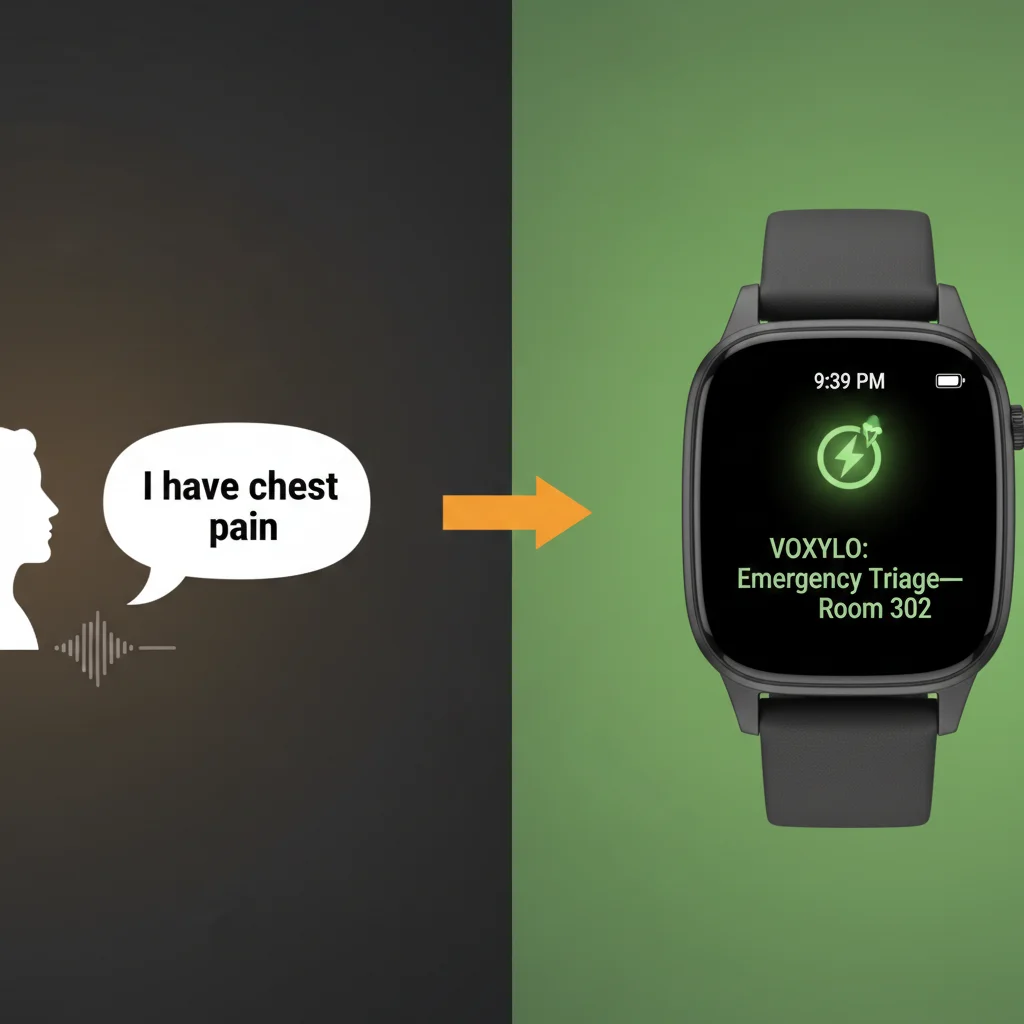
Navigating ai symptom checker risks requires a system that knows its own boundaries. VOXYLO is programmed with specific medical triage logic to identify urgency. When it recognizes critical keywords like "chest pain," it immediately escalates the interaction to ensure patient safety.
The ROI Modeling: Quantifying Efficiency and Growth
To move from concept to boardroom reality, we must analyze the economic impact through measurable Return on Investment (ROI). VOXYLO operates on two primary financial levers:
The Efficiency Lever: Operational Cost Reduction
Hospitals can operate with a leaner, higher-skilled team by automating 80% of routine inquiries. This leads to a 60% reduction in call center manpower and reclaims 60-70% of administrative time for complex care coordination.
The Growth Lever: Revenue Protection
VOXYLO plugs "leaks" in the patient acquisition funnel. Facilities can recover 15-20% of revenue previously lost to empty slots through "Smart Rescheduling". Furthermore, 24/7 availability ensures 100% lead capture, eliminating the 30% missed call rate common during peak hours.
Strategic FAQs: The C-Suite Perspective
How do we manage ai symptom checker risks and clinical safety?
VOXYLO is built on a "Vertical AI" core, fine-tuned specifically on medical datasets to minimize hallucinations. It uses strict clinical decision support AI logic to recognize urgent keywords like "chest pain" and immediately escalates the call to a human Medical Officer, ensuring it never attempts a diagnosis.
What about the "uncanny valley"? Do patients hate talking to AI?
Patient dissatisfaction usually stems from long hold times and complex "Press 1" menus. VOXYLO uses ultra-low latency engines (<500ms) to ensure zero-latency responses that feel natural. It provides consistent and tunable empathy, which often exceeds the performance of a stressed, overworked human operator.
Is our data secure under these new ai in clinical triage models?
Security is the foundation of the architecture. VOXYLO is fully compliant with HIPAA, GDPR, and PDPA. All data is encrypted using TLS 1.3 in transit and AES-256 at rest, and the system automatically redacts PII from analytics logs.
Can it handle our diverse local population?
Yes. The system features multilingual support, auto-detecting and speaking over 30 languages to cater to diverse patient populations without needing to hire specialized staff for every dialect.
How long is the disruption during implementation?
We use a "Plug-and-Play" methodology. The transition from discovery to "Go-Live" typically takes 14 days, starting with a "Shadow Mode" phase to fine-tune the AI's vocabulary against your hospital's specific call flows.
Conclusion: The Future of the Autonomous Front Desk
The line between chatbot vs doctor diagnosis must remain absolute to protect patient safety. However, the line between manual administration and patient triage automation is rapidly blurring. As we look toward the next decade of healthcare, the facilities that thrive will be those that treat their "Digital Front Desk" as a strategic asset rather than a utility.
By navigating regulatory limits ai diagnosis while maximizing the efficiency of ai chatbot triage healthcare, VOXYLO allows clinicians to return to their true calling: the art of medicine. The future isn't about replacing the human touch; it's about using AI to remove the administrative noise that prevents the human touch from happening in the first place.
Ready to Modernize Your Patient Flow?
Don't let administrative bottlenecks and a $150 billion no-show crisis undermine your clinical excellence. Deploy a specialized Digital Front Desk designed for the 2025 healthcare landscape.